
Items
Tag
art
-
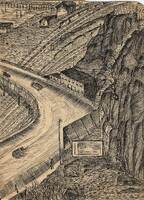 Drawing - Pershing Road - Peter Fiordalisi Pen and ink drawing of Pershing Road by Weehawken artist Peter Fiordalisi and dated 1938. Peter Fiordalisi was born in Union City, N.J. in 1904 and resided in Weehawken and West New York, NJ until his death in 1988. He studied art at the Mechanics Institute in New York City, and was trained as a metal engraver in the jewelry trade. Fiordalisi's work has been exhibited in many museum shows including: The Newark Museum, Montclair Museum, NJ and Brooklyn Museum, NY. His work is well-regarded in the the metropolitan area since he documented the NYC skyline and Palisades region in a multitude of mediums. His works include water colors, oils, wood-cut prints, pastels, college, pen and ink, and pencil drawings. Fiordalisi was a founding member and first president of the Hudson County Artist Guild.
-
 Grotesque Songs Weehawken's role as a generic humorous place name can be traced back to at least November of 1867, when this essay, entitled Grotesque Songs was published in a New York bi-annual magazine called The Galaxy, Magazine of Entertaining Reading, Vol. IV, May, 1867 to December, 1867. Text of the relevant passage: ... Let me observe, secondly, that, though the scene will probably be laid in the city, yet there must be some reference to Hoboken, Jersey City, Communipaw, Weehawken, Staten Island, Coney Island, Gowanus or, at least, Brooklyn. There is something in the association of ideas induced by the mention of these places which is exceedingly humorous and pointed. It would be nonsense to say that a horse on Broadway was frightened at the sight of a man, but when it is said that he was frightened at the sight of a Jersey man, it is entirely explicable and exceedingly vivid and witty. This is why the burlesque orator is so funny when he exclaims: What if Horace Greeley does emancipate Jersey over to Weehawken, are we to be dismembered from Coney Island and the Communipaw oyster beds? Certainly notnot if this court knows herself and she thinks she do. Thus, also, we are immediately interested in the song of Isabella with the gingham um-brer-ella., when we hear that her father kept a barber shop in Wee-haw-ken. Published by WC and FP Church, 39 Park Row, New York.
-
 Frank Tashlin For almost fifty years, since the cineaste-filmmakers of the French New Wave first heralded him, the films of Frank Tashlin have been viewed through a single lens. As one of the two studio-era Hollywood directors to make the jump from animation to live-action (Gregory La Cava is the other), Tashlin has long been seen as a director whose cartoons somehow resemble features, and whose features are somehow cartoony (1). Though his work comes up for minor re-evaluation every twenty years or so, the critical approach to Tashlin's work has been remarkably consistent. It is as if this one fact about this career is the only one that matters; the hook seems to be too good to resist... This site contains an article about director Frank Tashlin, a native of Weehawken who brought us many films ranging from 'Hare Remover' to 'Cinderfella.'
-
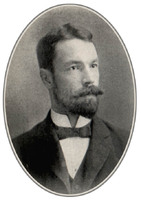 Photograph: Karl Bitter Prominent Viennese sculptor Karl Bitter had a studio here in Weehawken from 1895-1915. This photo, taken by an unknown photographer, appeared in The Criterion on May 19,1901. This image was found on the University of Buffalo web site by WHC member Willie Demontreux.
-
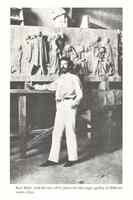 Photograph: Karl Bitter Karl Bitter was a famous Viennese sculptor who resided and worked in Weehawken from about 1895 until his death in 1915. Bitter bought the Rheinish Castle at the demise of the Eldorado Amusement Park and transformed it into his atelier. He also built a home for his family on the current site of Hamilton Park. Caption: Karl Bitter with his oak relief panels for the organ gallery of Biltmore estate, 1895. This photograph is from the book: KARL BITTER ARCHITECTURAL SCULPTOR 1867-1915 by James M. Dennis, Copyright, University of Wisconsin Press, 1967. The book is in the collection of the Weehawken Historical Commission.
-
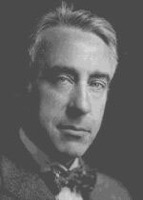 John Erskine's Weehawken Boyhood The following information was given to the Time Machine by Bob Schwartz: A novelist, poet, musician, and educator, John Erskine was a well-known figure in the cultural world of early 20th century New York City. While he never attained the national prominence of contemporaries like F. Scott Fitzgerald or Ernest Hemingway, his life was nonetheless marked by distinction. As a professor of literature at Columbia from 1909 to 1937 his influence was said to have 'extended beyond the College to affect all of American education.' In 1925 he began a prolific career as a novelist with the publication of The Private Life of Helen of Troy (a somewhat daring title for the those times), and in recognition of his accomplishments as a composer and pianist Erskine was named first president of the Juilliard School of Music, a position he would occupy for nearly a decade. Impressive credentials no doubt, but the particular Weehawken connection is in his autobiography, A Memory of Certain Persons. John Erskine has also left us a vivid but tantalizingly brief account of his boyhood in Weehawken. Born in Manhattan in 1879, John Erskine was three years old when his father, a ribbon manufacturer, moved both his business and his family across the river. Their new home was a 'large and comfortable' house on Pleasant Avenue in Weehawken; the factory was located a little farther west, in what was then called Union Hill. As Erskine points out, this arrangement reflected the fact that the two adjoining townships were in essence worlds apart. The busy streets that crisscrossed the thriving working-class community of Union Hill all came to an abrupt halt when they reached Weehawken; there, nature still held sway, adorned in places by an elegant residence or palatial estate. After a series of financial reverses Erskine's father was forced to sell the house and factory, and in 1900 the family moved back to New York City; by then, however, his son had already begun his long association with the college that was to have such a major impact on his life. Yet the years in New Jersey, too, seem to left a deep impression: Erskine was later to write that 'I did not yet realize the influence that Weehawken memories would have on me always.' In reading these excerpts keep in mind that the 'Boulevard' mentioned by the author is neither Kennedy Boulevard nor Boulevard East but actually present-day Park Avenue. Although marked on maps of the period as 'Bull's Ferry Road,' it was apparently long enough and wide enough to be considered a 'boulevard' by the local inhabitants. (The Boulevards as we know them were constructed during the years 1894-1897.) Fliegende Blaetter, or "Flying Leaves," was a satirical German magazine first published in 1842. It featured the work of Wilhelm Busch, a cartoonist who catalogued the fiendish antics of two young boys, Max and Moritz, in what is considered to be the world's first comic-strip. Americans are (or were) more familiar with the "Katzenjammer Kids," their direct descendants. Grace Episcopal Church, which Erskine's father helped build, is still standing and has kept its original name; Gardner Street, however, is now known as 40th Street. The venerable church has also managed to hold on to something else through the many years: trees. Sparse as they are, they can still serve to remind us of the 'stately groves' and 'parklike grounds' that once abounded on the Weehawken side of the 'Boulevard,' and perhaps prompted the name-change to Park Avenue.
-
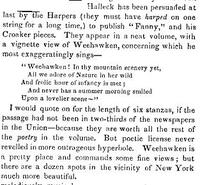 Review of Fitz-Halleck's Poem 'Weehawken' This review appeared in the Southern literary messenger; devoted to every department of literature and the fine arts, Volume 5, Issue 9, dated September, 1839. It is part of an article called 'Letters from New York - No. II' with a byline of 'Probus'.
-
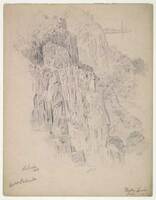 Hudson Palisades by Martin Lewis Pencil sketch of the Palisades with New York inthe background, signed and dated 1909 by artist Martin Lewis.
-
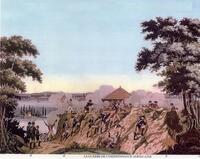 Mural - La Guerre D'Independance This picture shows panels 1 through 6 of a mural called La Guerre D'Independance by the artist Deltel. This woodblock print was first printed in 1852-1853. This first section of the mural depicts the attack on and capture of a fort on 'Weehawk Hill' by American volunteers and Militia as well as the troops of French General Lafayette. The complete mural can be seen in only two places - the White House and Mexico High School in Mexico, NY. The latter has an excellent web page which shows the entire mural in sections. This page also has information on the history of the mural. Thanks to Willie Demontreux for finding this image. Some further thoughts on this image... according to Bob Schwartz, who is well versed in the revolutionary war here in Weehawken and environs, this battle is most probably an invention of Deltel's. If you look closely at the painting, it seems to be a combination of a well known print of Weehawken with the battle added on top of it. Bob also notes that other parts of the mural (Cornwallis' surrender of his sword and Washington's supposed battle near Niagra Falls) are just as invented.
-
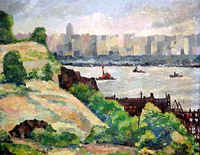 Paintings by Weehawken Artist Peter Fiordalisi All images and biographical information on this page are courtesy of The TheDeepArchives.com Gallery PETER FIORDALISI - New Jersey Artist (1904-1988) Peter Fiordalisi was born in Union City, N.J. in 1904 and resided in Weehawken and West New York, NJ until his death in 1988. He studied art at the Mechanics Institute in New York City, and was trained as a metal engraver in the jewelry trade. Fiordalisi's work has been exhibited in many museum shows including: The Newark Museum, Montclair Museum, NJ and Brooklyn Museum, NY. His work is well-regarded in the the metropolitan area since he documented the NYC skyline and Palisades region in a multitude of mediums. His works include water colors, oils, wood-cut prints, pastels, college, pen and ink, and pencil drawings. Fiordalisi was a founding member and first president of the Hudson County Artist guild.
-
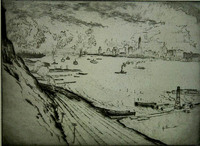 Norfeldt - New York Harbor from Weehawken - 1915 Bror Julius Olsson Nordfeldt (Swedish-American, 1878-1955) NEW YORK HARBOR FROM WEEHAWKEN, NEW JERSEY, ca. 1915. Signed in pencil, printed by the artist, and noted in pencil, "Selected Proof B.J.O.N." This is a view from a pier on the New Jersey side of the Hudson River, looking across to the west side of Manhattan. Etching and drypoint, 9 3/8" x 12 3/4" Image provided by Willie Demontreux.
-
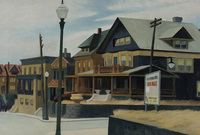 East Wind Over Weehawken - Edward Hopper Painting of houses on Boulevard East (at 49th Street) by Edward Hopper (1882-1967). Oil on canvas and 34 x 50 inches, painted in 1934. The painting was held in the collection of the Pennsylvania Academy of Fine Arts in the United States from 1954 until its sale to an anonymous buyer in December 2013. That sale brought a record price for a Hopper painting.
-
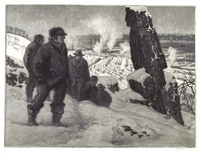 Engraving - Above the Yards, Weehawken Engraving by Martin Lewis, circa 1918. Only 15 copies of this engraving were made. The original is approximately 17 by 23 inches in size and is currently being offered for sale by The Old Print Shop in NYC (www.oldprintshop.com) for $15,000.
-
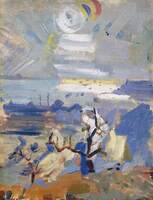 John Marin: Weehawken Painting - Weehawken, 1903-1904 by artist John Marin. Oil on panel, 9.25 x 12 inches Signed verso "Painted between 1903-1904/John Marin" John Marin was born in Rutherford, New Jersey in 1870. In addition to attending public school in Weehawken, New Jersey, Marin's other schooling included Hoboken Academy, Stevens Preparatory, and the Stevens Institute. He worked in an architecture firm for four years and was a free lance architect for one year. He then spent two years at the Pennsylvania Academy of the Fine Arts in Philadelphia (with Thomas Anschutz and William Merritt Chase from 1899-1901) and one year at the Arts Students League, New York (1902-03). Inspired by Whistler, Marin went to Paris in the summer of 1905, where he briefly attended the Academie Julian, and stayed abroad for four years visiting Amsterdam and the Belgium coast, Italy (Rome, Florence, and Venice), London, Bruges, Antwerp, and Brussels. In 1907 his oil painting The Mills at Meaux was purchased by the French government for the Luxembourg Museum. He continued to produce etchings (103 while in Paris) and oils (exhibited paintings in the Salon des Independents) and also watercolors. When he returned to the United States in, Marin's career was launched before the American people when he exhibited his watercolors at Stieglitz's gallery, "291" in New York. Marin went back to Europe one last time in the spring of 1910 where he painted in the Tyrol, returning to the U.S. in 1911. He married in 1912 and after living in Brooklyn and New York, moved to Cliffside, New Jersey in 1916. He spent his summers in Maine, Massachusetts, New York, New Hampshire, Pennsylvania, and New Mexico. Marin died in Cape Splint, Maine in October 1953. John Marin's original and bold fluid style earned him a place as one of America's greatest early modernists. In his lifetime, John Marin's works were exhibited frequently in major exhibitions and museum retrospectives. Among these were the Armory Show in 1913; Museum of Modern Art in 1936; Boston Institute of Contemporary Art; Walker Art Center in 1947; de Young Museum, San Francisco; Santa Barbara Museum; Los Angeles Museum of Art in 1949; Munson-Williams Proctor Institute in 1951, and the Houston Museum of Fine Arts in 1953. Marin's works continue to be exhibited and are represented in the important collections of the United States. John Marin produced his famous Weehawken series from 1903-1904, which consisted of about a hundred small oil paintings on canvas board. Marin, himself, dated these works and they related to his life at that time. Ranging from a daring representational style to almost complete abstraction, they anticipate the later work of the Fauves and abstract art. Image provided by Willie Demontreux. Thanks to Bernie Zempolich for this link!
-
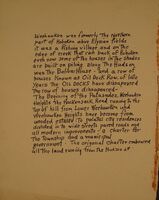 Untitled Sketchbook - Grant Wright - 1934 Sketchbook by artist Grant Wright, dated 1934.
-
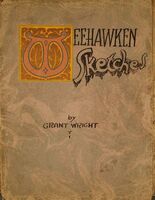 A Few Sketches of Weehawken - 1934 Weehawken Sketches by artist, Grant Wright, dated 1934.
-
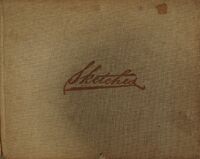 A Few Sketches of Weehawken - 1926 Sketchbook of Weehawken by artist, Grant Wright, dated 1926. This is the earliest sketchbook in the Commission's collection.
-
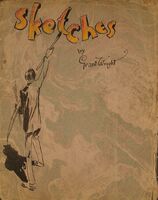 A Few Sketches of Weehawken - 1933 Sketchbook of artist, Grant Wright, dated 1933.
-
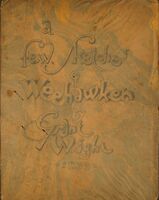 Grant Wright's Weehawken Sketches - 1933 Sketches of Weehawken in 1933, by artist Grant Wright.
-
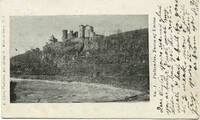 No. 1 - Palisades, Town of Union This black and white undivided photo postcard shows Karl Bitter's home and studio. This card was published by E. Ufert, 502 Spring Street, West Hoboken, NJ. Postmarked November 8, 1905 from Weehawken.
-
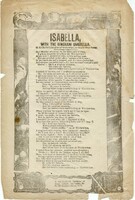 Song Lyrics: Isabella, With the Gingham Umbrella Song lyrics from the rousing ditty 'Isabella With the Gingham Umbrella, or The Barber's daughter of Weehawken, as sung by Tony Pastor.' Published by H. De Marsan of New York City, date unknown.