
Items
Tag
transportation
-
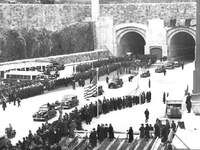 Photograph - Lincoln Tunnel Opening Festivities Black and white photo, dated 1937. Caption: GIGANTIC TUNNEL IS OPENED, NEW YORK CITY -- Manhattan Island is lined again with the mainland, this time by the magnificent $85,000,000 Lincoln Tunnel crossing under the Hudson to Jersey from mid-town New York. Brilliant ceremonies mark the opening of one tube of the tremendous project.
-
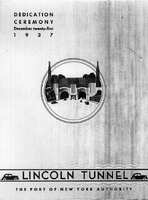 Program - Lincoln Tunnel Dedication - Dec 21 1937 This document is a program of activities surrounding the dedication of the Lincoln Tunnel, which took place in Weehawken and that other town on the other side of the Hudson on December 21, 1937.
-
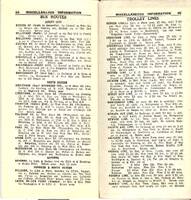 North Hudson Public Transportation Information from 1926 These pages contain information from the 1926 edition of The Red Book street guide covering Jersey City and the other North Hudson communities. You'll find bus, ferry, trolley and train schedules and fares. This item is in the collection of Willie Demontreux.
-
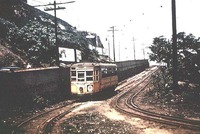 Trolley Coming Up Pershing Road Photograph of a Public Service trolley coming up Pershing Road from the ferry, found on the excellent RailFan web site.
-
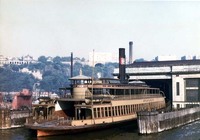 New York Central Ferry Stoney Point Photograph of the New York Central Ferry Stoney Point at Weehawken found on the excellent RailFan web site.
-
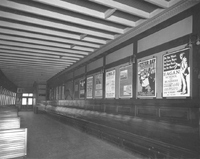 Interior of the NY Central Ferry Boat Albany These two black and white photos show the interior of the New York Central Railroad ferry boat Albany some time in the 1930s, when it crossed the Hudson between New York and Weehawken. Note the ad for Eagan Business Schools, whose founder and president was Weehawken resident John J. Eagan. These photos were found by Willie Demontreux on the excellent web site Railfan which has a treasure trove of old railway photos.
-
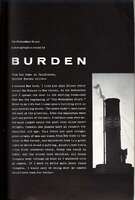 The Weehawken Story - Gentry Magazine - Winter 1956-1957 A photographic essay on the end of the Weehawken Ferry by photographer Shirley Burden which appeared in the Winter 1956-57 issue of Gentry Magazine on page 61. This item is in the collection of Willie Demontreux.
-
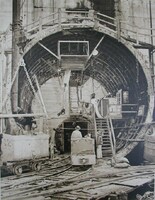 Photograph - 3rd Tube - Lincoln Tunnel Photograph of the third tube of the Lincoln Tunnel under construction.This photograph won first prize in the Industrial Clas of the Graflex Photo Contest. It was taken by Tim Sheehan of 17-07 Parmlee Avenue of Fairlawn, NJ.
-
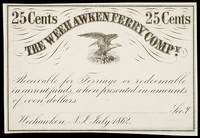 Weehawken Ferry Note for 25 Cents Note for twenty five cents from the Weehawken Ferry Company, dated July 1862. The note states that it is Receivable for Ferriage or redeemable in current funds when presented in amounts of even dollars.
-
 NJ Route 85 - The Palisade Avenue Freeway From 1956 through the 1970s, there was serious talk of replacing Palisade Avenue with a 10 lane freeway, connecting I-78 in Jersey City with the George Washington Bridge. The new highway, which would have been NJ Route 85 was never built. You can read the story of this road that never was on the nycroads.com web site.
-
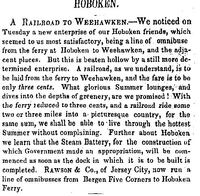 A Railroad to Weehawken Article from the New York Times, April 1, 1853, page 3. Article text: A RAILROAD TO WEEHAWKEN - We noticed on Tuesday a new enterprise of our Hoboken friends, which seemed to us most satisfactory, being a line of omnibuses from the ferry at Hoboken to Weehawken, and the adjacent places. But this is beaten hollow by a still more determined enterprise. A railroad, as we understand, is to be laid from the ferry to Weehawken and the fare is to be only three cents. What glorious Summer lounges and dives into depths of greenery are we promised! With the ferry reduced to three cents and a railroad ride some two or three miles into a picturesque country for the same sum we shall be able to live through the hottest summer without complaining...railroad, as we understand, is to be laid from the ferry to Weehawken and the fare is to be only three cents. What glorious Summer lounges and dives into depths of greenery are we promised! With the ferry reduced to three cents and a railroad ride some two or three miles into a picturesque country for the same sum we shall be able to live through the hottest summer without complaining...
-
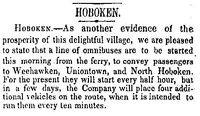 Hoboken Omnibuses From the New York Daily Times - March 29, 1853 As another evidence of the prosperity of this delightful village, we are pleased to state that a line of omnibuses are to be started this morning from the ferry, to convey passengers to Weehawken, Uniontown and North Hoboken. For the present they will start every half hour, but in a few days, the Company will place four additional vehicles on the route, when it is intended to run them every ten minutes.
-
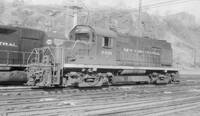 New York Central RR Locomotive 2021 at Weehawken Black and white photo of NYCRR locomotive, taken on February 3, 1968.
-
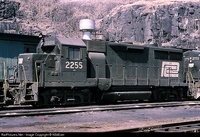 Penn Central Locomotive at Weehawken Colored photo of Penn Central locomotive (type EMD GP35) shown at Weehawken on November 10, 1974. 88181,ConRail Locomotive at Weehawken,This ConRail locomotive (type EMD SD45) is shown at Weehawken on September 14
-
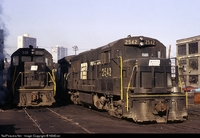 Penn Central Locomotive at Weehawken This Penn Central locomotive (type U25B) is shown at Weehawken on February 24, 1974. Photo reproduced with the kind permission of Andy Koenigsberg of RailPictures.Net.
-
 Historic American Engineering Record - Lincoln Tunnel The Historic American Engineering Record, maintained by the Library of Congress, documents achievements in architecture, engineering, and design in the United States and its territories through a comprehensive range of building types and engineering technologies including examples as diverse as the Pueblo of Acoma, houses, windmills, one-room schools, the Golden Gate Bridge, and buildings designed by Frank Lloyd Wright. This set of aerial photographs, taken in October 1991, documents the Lincoln Tunnel and its surroundings.
-
 Working Together Produces Results in Weehawken - World Tunnelling This article from the December 2003 issue of World Tunnelling magazine describes the process of rehabilitating the West Shore Railroad Tunnel for use in the new Hudson Bergen Light Rail Project.
-
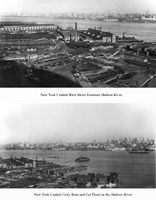 Photos of the Weehawken Rail/Ferry Terminal - 1930s These photos, as well as the description below, were posted on the www.railfan.net site by 'waterlevel,' the moderator of the forum which deals with the New York Central's Marine Operations: Photographed from the Weehawken bluffs the photos were taken in the late 1930's. The Rochester is seen in the ferry slip and two New York Central tugboats are approaching the yards in the middle of the first photo. Just below the large smokestack is a dark building that was the Public Service trolley shed. To the left was where Railway Express operated out of. On the upper left were where the railroad boxcars waited to be loaded onto the car floats and beneath them are the New York Central passenger cars for the West Shore Line. There was a diner located in the trolley shed and just up the street was a place for the workmen to buy their work clothes. Inside the railroad terminal was a large waiting room with long wooden benches and a news stand that sold newspapers, magazines, candy and other items to the commuters. It was run by the Union News Company. Within a few years this terminal was critical to the WWII effort in moving tanks, artillery, ambulances, jeeps, duce and a halfs and other war material to waiting ships in the Port of New York. Many Army personnel saw their last of America from this spot since the trains brought them from New York State through New Jersey and then by ferry to the troop transports. In four years the ferries would be the in the transport loop once again by ferrying prisoners of war to the holding camps in New York. In 1927 the ferries carried 27,044,102 people crossing the Hudson by ferry. By 1954 the number had dropped to 429,588 people. The ferries closed down in 1959.
-
 The New Yorker: Route 3 From Our Correspondents: Route 3by Ian Frazier Article from:The New YorkerIssue of Feb 16/23, 2004 This article, about NJ Route 3, includes an interview with Weehawken Historical Commission Chair Edward Fleckenstein about the possible locations of the Burr-Hamilton Duel.
-
 Historic American Engineering Record - West Shore Railroad Tunnel This document is a description of the West Shore Railroad Tunnel which runs under 48th Street from the water front. This report was prepared in 1997 by industrial archeologist Thomas Flagg for the Historic American Engineering Record. The document images are from the collection of the Library of Congress in Washington DC.
-
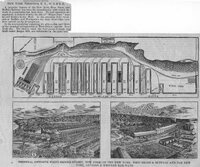 New York Terminus, N.Y., W.S. and B.R. This undated clipping shows a diagram of the layout of the railroad terminal of the New York, West Shore and Buffalo Railroad at Weehawken.
-
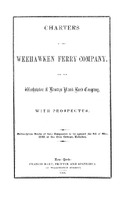 Charters of the Weehawken Ferry Company and Weehawken and Ramapo Plank Road Company This 1853 document contains the charters of these two companies as well as a prospectus for investors. It is 19 pages long.
-
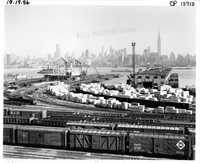 Photo of Erie Railroad Weehawken Terminal - 1956 Tom Flagg, who provided this image and associated information writes: This is a photo of the Erie Railroad's Weehawken waterfront terminal, facing east, dated 10-19-1956. It is from the Port of New York Authority's Public Relations files (as the stamp in the sky reveals). The piled boxes are crated export machinery awaiting the call to be transferred to barges, which will then deliver them to ships anywhere in the Port.
-
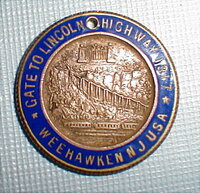 Medallion - Gate to Lincoln Highway -1917 This 1917 medallion depicts the Palisades, with train passing at bottom, the Grauert Causeway traveling up the cliffs, a gate with two stone piers at the top, and is marked 'Gate to Lincoln Highway - 1917' and 'Weehawken, NJ USA' The Lincoln Highway was the first road to traverse America.